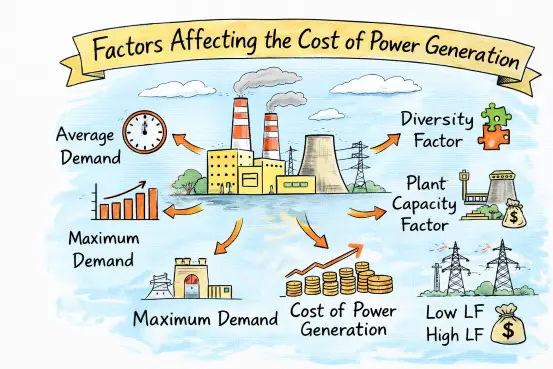
The cost of electrical power generation depends on how efficiently a power plant is planned, operated, and utilized. Engineers analyze several technical factors such as demand, load behavior, plant capacity, and system diversity to minimize generation cost while maintaining reliable supply. Understanding these aspects is crucial in the field of power system economics.
Let us understand these factors step by step, in simple language.
1. Average Demand
Average demand is the average electrical load supplied by a power station during a specific period.
It can be calculated for:
- A day
- A month
- A year
Daily Average Demand = Energy generated in 24 hours / 24
Monthly Average Demand = Energy generated in a month / (24 × number of days)
Annual Average Demand = Energy generated in a year / (24 × 365)
2. Maximum Demand
Maximum demand (also called peak demand) is the highest load on the power system during a given period.
- Measured in kW or MW
- Determines:
- Generator size
- Transformer rating
- Transmission capacity
- Power stations must be designed to safely handle maximum demand, even if it occurs for a short time.
3. Demand Factor
Demand factor shows how much of the connected load is actually used.
Demand Factor = Maximum Demand / Connected Load
E.g., if Maximum Demand = 70 MW
Connected Load = 100 MW
Demand Factor = 0.7 (Unitless Quantity)
- Demand factor is Always less than 1
- Indicates realistic usage of installed equipment
- A lower demand factor helps in reducing capital cost.
4. Plant Capacity Factor
Plant capacity factor indicates how effectively a power plant is utilized.
Plant Capacity Factor = Actual Energy Generated / Maximum Possible Energy
Plant Capacity Factor = Average Demand x T (Hr)/ Plant Capacity x T (Hr)
Plant Capacity Factor = Units generated per Annum / Plant Capacity x Hours (Years)
Reserve Capacity = Plant Capacity − Maximum Demand
5. Plant Use Factor
Plant use factor considers only the hours for which the plant actually operated.
Plant Use Factor = Energy Generated / (Plant Capacity × Hours of Operation)
Plant Use Factor = Maximum Demand / Plant Capacity
- Useful when plants do not operate continuously.
6. Diversity Factor
Diversity factor explains why not all consumers use maximum power at the same time.
Diversity Factor = Sum of Individual Maximum Demands / Coincident maximum demand of the system
- Always greater than 1.
- Higher diversity factor → lower cost of generation.
- This is one of the most important economic advantages in power systems.
- A diversity factor equal to 1 would mean all loads peak simultaneously, which is highly unrealistic and would require maximum capacity at all times
In real electrical systems, all loads do not reach their maximum demand at the same moment. Because of this natural variation in usage, power systems can be designed with smaller and more economical equipment. Different types of electrical loads, such as lighting, motors, household appliances, and industrial machines, operate at different times. For example, cooking loads increase in the evening, lighting demand rises at night, and industrial loads peak during working hours. Since these peaks do not overlap fully, the total system demand remains lower than the sum of individual peaks.
A higher diversity factor (always greater than 1) is considered beneficial, as it shows that although the connected load is large, the actual maximum demand on the system is much lower. This directly helps in reducing both generation cost and infrastructure requirements.
Importance in Electrical Power Systems
- Cost Reduction: A higher diversity factor enables generators, transformers, and feeders with lower capacities to supply a larger connected load. This significantly reduces both capital investment and operating expenses.
- Efficient System Planning: The diversity factor is crucial in power system design, guiding engineers in accurately sizing substations, cables, and equipment. This prevents unnecessary oversizing and associated costs.
- Optimized Infrastructure: By considering the diversity factor, utilities can avoid building costly, oversized infrastructure for rare worst-case scenarios. This leads to more efficient resource utilization and cost savings.
7. Load Factor
Load factor shows how efficiently we are using electrical power over a period of time.
Load Factor = Average Load / Maximum Demand
Load Factor = Average Load x T (Hr) / Maximum Demand x T (Hr)
Load Factor = Energy Generated / (Maximum Demand × Time)
- Load factor is always less than 1
- A high load factor means:
- Smaller plant capacity needed
- Lower fuel cost
- Lower cost per unit electricity
A higher load factor indicates that the difference between the average load and the maximum demand is small. When the maximum demand is lower, it can be met using a power plant of smaller capacity. A lower plant capacity results in reduced initial investment as well as lower operating and maintenance costs. Consequently, the cost of electricity generated per unit decreases.
The load factor is always less than 1, since the average load can never exceed the peak load. A high load factor is desirable because it shows that the power plant is being utilized more uniformly and efficiently, leading to better performance and reduced generation cost.
8. Plant Load Factor (PLF)
PLF shows the actual utilization of installed capacity.
PLF = (Actual Generation / (Installed Capacity × Time)) × 100 %
- High PLF → Efficient plant
- Low PLF → Downtime or poor utilization