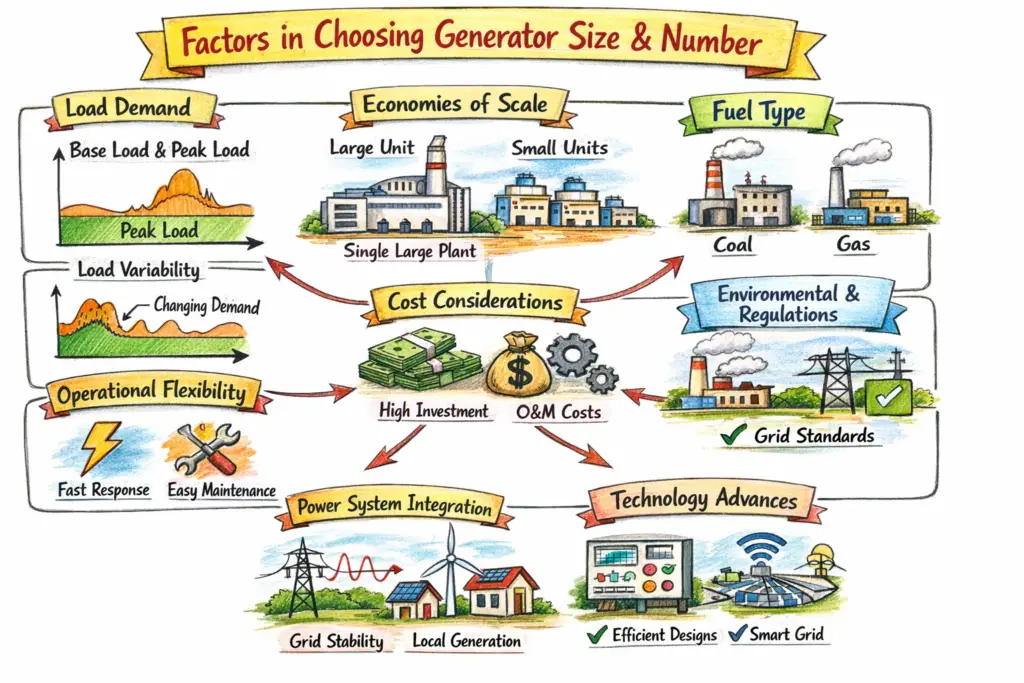
The choice of size and number of generator units is a crucial aspect of power system planning and power plant design. It involves deciding whether to install a few large generators or several smaller ones based on factors such as load demand pattern, fuel availability, operational flexibility, cost, reliability, environmental regulations, and grid requirements.
This selection process ensures that electricity is generated economically, supplied reliably, and operated flexibly while meeting environmental and grid standards. A proper balance between generator capacity and quantity helps achieve efficient power generation and stable system performance.
1. Load Pattern Analysis
- Maximum Load and Continuous Load: Every power system has a minimum continuous demand (base load) and occasional high demand (peak load). Generator capacity must safely handle peak conditions without overstressing equipment.
- Fluctuating Demand: When demand changes widely during the day or across seasons, installing several smaller generators often provides better operational control than a single large unit.
2. Scale Economy Considerations
- Large-Capacity Units: Bigger generators usually deliver electricity at a lower per-unit cost because of improved efficiency. However, failure of one large unit can remove a major portion of total capacity.
- Smaller Units: Using multiple small generators increases system reliability. If one unit goes offline, the remaining units can still supply power.
3. Type of Fuel Used
- Fuel Behaviour: Different fuels influence generator sizing. Gas-based plants allow smaller, fast-starting units, while coal or nuclear stations generally employ large machines due to slow startup and steady operation needs.
- Fuel Supply and Price: Easily available or low-cost fuel sources often justify installing higher-capacity generators.
4. Operating Flexibility
- Speed of Response: Systems that require rapid load changes—especially those combined with renewable sources like wind or solar—benefit from smaller or modular generators.
- Maintenance Planning: Multiple units make it easier to perform servicing without interrupting overall power supply.
5. Investment and Running Expenses
- Capital Cost: Large generators usually reduce cost per MW but demand high upfront investment. Financial capability strongly affects this choice.
- Operation & Maintenance: Smaller machines may have higher operating costs, yet they reduce risk and improve supply continuity.
6. Environmental and Regulatory Factors
- Emission Limits: Generator size affects pollution levels. Environmental regulations may restrict unit capacity or mandate cleaner technologies.
- Grid Codes: Power utilities must follow grid stability rules, which influence both number and size of generators.
7. Power System Integration
- Grid Stability: A balanced mix of generator sizes helps maintain voltage and frequency stability.
- Local Generation Trend: Modern systems increasingly favor smaller generators placed near consumers to reduce transmission losses.
8. Modern Technology Impact
- Improved Efficiency: New designs allow compact generators to achieve higher efficiency, making multiple small units more attractive.
- Smart Grid Support: Advanced control systems can coordinate several small generators effectively, enhancing reliability and energy management.
Overall ,the choice of generator size and quantity depends on load behavior, fuel type, economics, flexibility, environmental rules, grid requirements, and modern technology. Large units offer efficiency, while multiple smaller units provide reliability and operational freedom.
Combined Operation of Power Stations (Interconnected System)
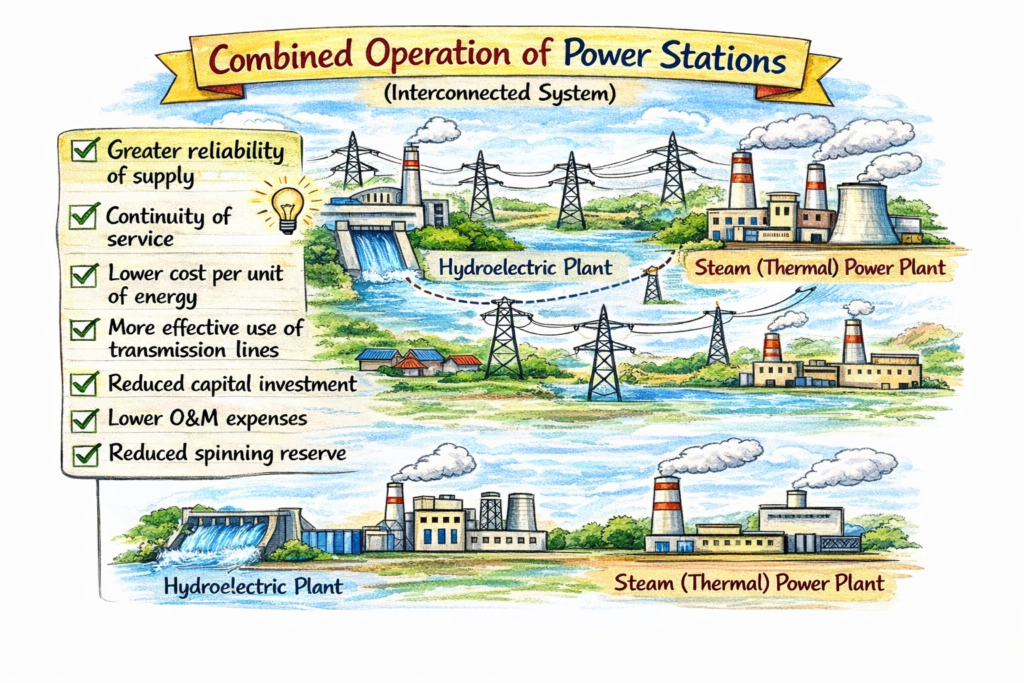
When two or more power plants are electrically linked and jointly supply electricity to consumers, the arrangement is called a combined or interconnected power system. Instead of operating independently, all stations work together to meet load demand efficiently and reliably.
Advantages of Interconnected Power Systems
- Improved Supply Reliability : If one station trips or shuts down, other stations continue supplying power, preventing total blackout.
- Continuity of Service : Consumers remain energized even during plant outages or maintenance.
- Lower Cost per Unit of Energy : Shared generation reduces overall production cost due to better utilization of resources.
- Efficient Use of Transmission Lines : High-voltage interconnection allows power to flow where needed, maximizing line capacity.
- Reduced Capital Requirement : Smaller individual reserve margins are needed, lowering total investment.
- Lower Operation and Maintenance Expenses : Supervision, staffing, and maintenance costs decrease when plants operate together.
- Reduced Spinning Reserve : Backup capacity required is less because multiple stations support each other.(Spinning reserve refers to standby generating capacity that can be activated within a few minutes and sustained for several hours.)
A common practical combination is hydro + thermal generation.
- Hydroelectric stations respond quickly to load changes and are excellent for handling peak demand.
- Thermal stations operate steadily and are better suited for continuous base load.
Seasonal Operation:
- During monsoon / high water availability:
→ Hydro plant acts as base load
→ Thermal plant handles peak load - During dry or drought periods:
→ Thermal plant becomes base load
→ Hydro plant supplies peak load
This coordinated operation ensures economical generation and stable supply throughout the year.
Hence ,combined operation of power stations connects multiple plants into one system to improve reliability, reduce costs, minimize reserve requirements, and optimize load sharing—especially effective when hydro and thermal plants work together.