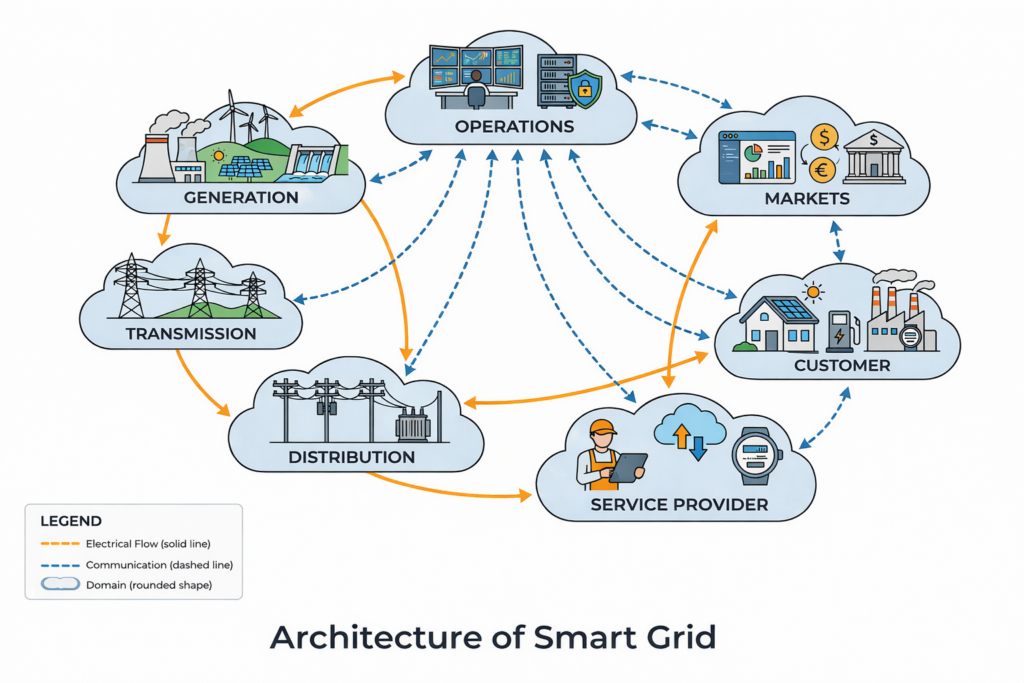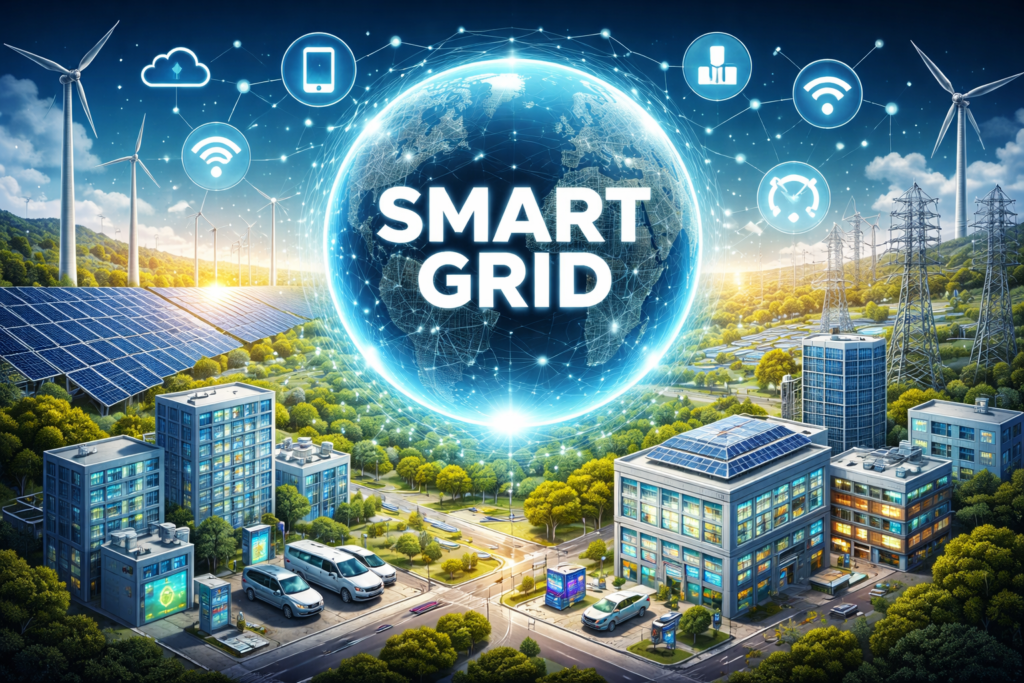
A Smart Grid is an advanced electrical power system that uses digital communication, automation, and information technology to generate, transmit, distribute, and consume electricity efficiently, reliably, and securely.
So a Smart Grid is an electricity network that uses smart technologies to:
- Monitor power flow in real time
- Detect faults automatically
- Improve efficiency and reliability
- Integrate renewable energy sources
Technologies Used in Smart Grid
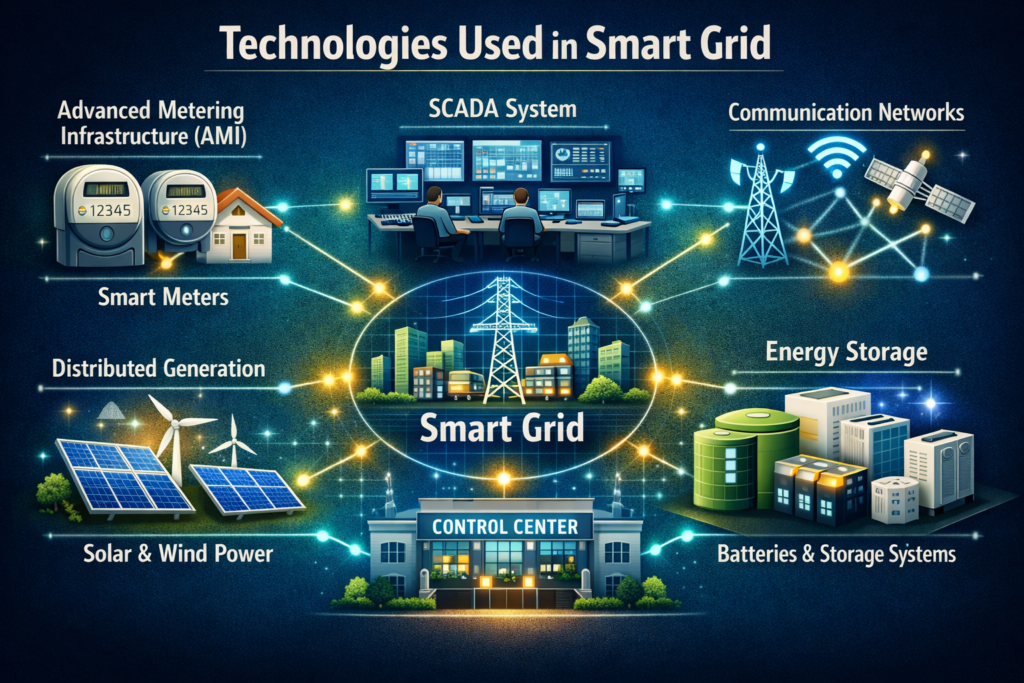
1️⃣ Advanced Metering Infrastructure (AMI)
- Uses smart meters
- Enables two-way communication between consumer and utility
- Helps in real-time billing and energy monitoring
2️⃣ Communication Technology
- Fiber optics, wireless networks, and power line communication
- Ensures fast and secure data transfer
3️⃣ Supervisory Control and Data Acquisition (SCADA)
- Monitors and controls substations remotely
- Helps in quick fault detection and restoration
4️⃣ Distributed Generation (DG)
- Integration of renewable sources like:
- Solar PV
- Wind energy
- Micro-turbines
5️⃣ Energy Storage Systems
- Batteries, flywheels, supercapacitors
- Stores excess energy and supplies during peak load
Difference Between Traditional (Conventional) Grid and Smart Grid
| Feature | Traditional Grid | Smart Grid |
|---|---|---|
| Communication | One-way | Two-way |
| Fault Detection | Manual | Automatic |
| Renewable Integration | Limited | High |
| Reliability | Low | High |
| Consumer Participation | No | Yes |
Advantages of Smart Grid
Smart grid offers multiple benefits:
- Improved reliability and power quality
- Reduced power losses
- Faster fault detection and recovery
- Efficient use of renewable energy
- Reduced electricity cost
- Environment-friendly operation
Applications of Smart Grid
Smart grids are widely used in:
- 🏠 Smart homes and smart cities
- 🏭 Industrial automation
- ⚡ Renewable energy integration
- 🚗 Electric vehicle (EV) charging
- 🌍 Microgrids and distributed systems
Author: E4ENGINEERS Team
Content Type: Original Educational Content
Last Updated: 2025